- Published on
- • 4 min read
Introducing NodeLLM: The Backend-First AI SDK for Node.js
- Authors

- Name
- Shaiju Edakulangara
- @eshaiju
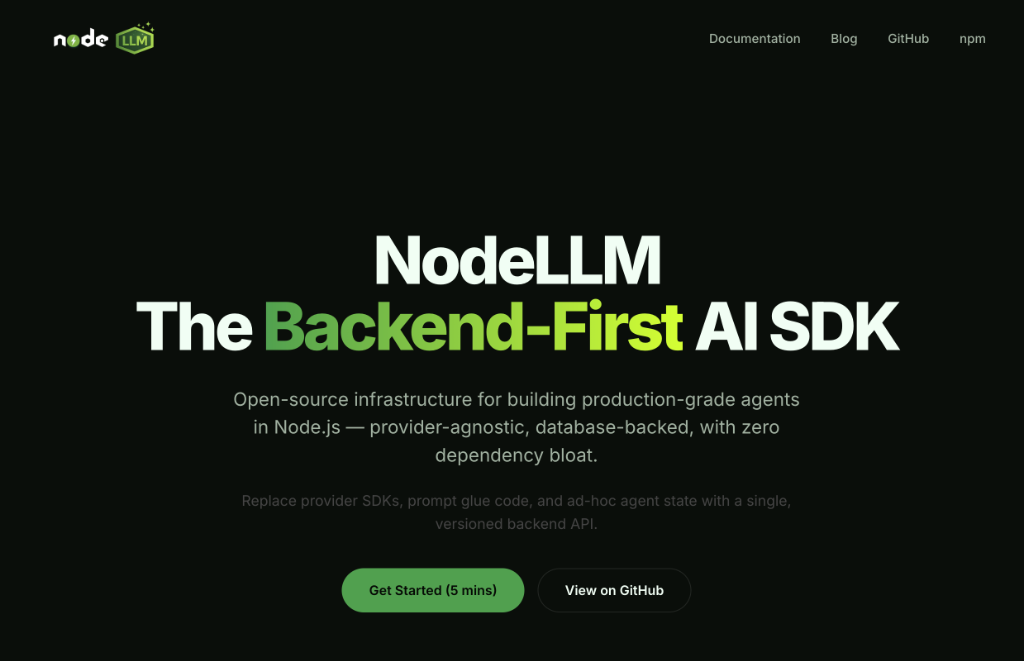
Over the past year, I’ve spent a lot of time working with RubyLLM, and I’ve come to appreciate how thoughtful its API feels. The syntax is simple, type-safe, and declarative — it doesn’t leak provider details into your application and lets you focus on the problem rather than the SDK.
When I tried to achieve that same experience in Node.js, I realised something was missing. NodeLLM is my attempt to bring that same level of architectural clarity and composure to the Node ecosystem.
Why This Matters
AI integration should be an architectural decision, not just an API call.
Most teams begin by wiring business logic directly to a provider SDK. When models change, pricing shifts, or APIs are deprecated, that coupling turns into painful refactors.
Problem Statement
Most developers are currently caught between two extremes: using raw vendor SDKs that lead to vendor lock-in, or adopting heavyweight "agent frameworks" that try to own your entire application architecture.
NodeLLM takes a different path.
It isn't a "framework" that forces you into a specific way of building agents; it’s an architectural layer. It treats LLMs like a database driver or a file system. It provides the connectivity and normalization you need, then stays out of the way so you can build your application logic however you see fit.
LLMs should be treated as infrastructure. NodeLLM exists to provide a stable, opinionated boundary between your application and a fast-moving AI ecosystem.
The NodeLLM Philosophy
Architecture over APIs
NodeLLM is not a thin wrapper. It defines a consistent interaction model across providers, so your system logic doesn’t change when models or vendors do.
import { createLLM } from "@node-llm/core";

// 1. Create a configured instance
const llm = createLLM({ provider: "openai" });

// 2. High-level chat interface
const response = await llm.chat("gpt-4o").ask("Explain event-driven architecture");

console.log(response.content);
First-Class Reasoning (R1 / o1)
The world of LLMs is shifting from simple completions to Reasoning Models. These models provide a "Chain of Thought" that is often lost in standard SDK outputs. In NodeLLM, reasoning is a first-class citizen. Every response includes a dedicated .reasoning property, allowing you to surface the model's inner logic for debugging or transparency.
const llm = createLLM({ provider: "deepseek" });
const res = await llm.chat("deepseek-reasoner").ask("Design a distributed lock");

console.log(res.reasoning); // Access the hidden chain-of-thought
console.log(res.content);   // The final answer
Tools Without Orchestration Hell
Defining tools shouldn’t require fragile JSON schemas or manual execution loops. NodeLLM provides a class-based DSL where tools are defined once and executed automatically by the runtime.
import { Tool, z } from "@node-llm/core";

class WeatherTool extends Tool {
  name = "get_weather";
  description = "Get current weather";
  schema = z.object({ location: z.string() });

  async handler({ location }) {
    return `Sunny in ${location}`;
  }
}

await chat.withTool(WeatherTool).ask("What's the weather in Tokyo?");
Scoped Parallelism
Real systems often need to evaluate multiple providers in parallel. NodeLLM allows isolated execution contexts without global side effects or API key collisions.
const [gpt, claude] = await Promise.all([
  NodeLLM.withProvider("openai").chat("gpt-4o").ask(prompt),
  NodeLLM.withProvider("anthropic").chat("claude-3-5-sonnet").ask(prompt),
]);
Built for Real Applications
NodeLLM supports the features you actually need in production:
- Zero-SDK Dependency — We don't wrap vendor SDKs. NodeLLM talks directly to APIs using standard protocols, keeping your production bundle lean and your security audit clean.
- Vision & Files — Images, PDFs, and audio with automatic encoding.
- Standardised Streaming — A single AsyncIterator interface.
- Deterministic Debugging —
NODELLM_DEBUG=trueshows exact payloads. - Type-Safe Structured Output — Integrated Zod validation.
Production Use Cases
NodeLLM is battle-tested and used as the core AI integration layer in production systems. If you’re building long-lived Node.js applications, NodeLLM is designed to grow with you — without locking you in.
npm install @node-llm/core
Documentation: https://nodellm.dev
GitHub: https://github.com/node-llm/node-llm